
Florence Directory Collections by Year
No complete publisher-and-year run for a Florence-only city directory was visible in the public library catalog. That is an important finding. The sound approach uses the confirmed regional volume and Boone County historical collections, then asks the archive desk whether an unpublished catalog record, print volume, microfilm reel, telephone book, or address-order directory fills the target year.
| Collection | Years found | Where held | Access |
|---|---|---|---|
| Florence or Boone municipal city directories | Exact run not confirmed | Ask BCPL archive desk | Targeted shelf, catalog, or microfilm check |
| Cincinnati and Hamilton regional directories | 1868 and 1972 items confirmed; more years in collection | Cincinnati & Hamilton County Public Library | Free digital viewer |
| Boone County Recorder | 1875-1973 digitized run described | BCPL Recollect archive | Online search plus page-image review |
| Walton Advertiser | 1916-1975 | BCPL archive and microfilm | Library or archive access |
| Cincinnati Enquirer | 1841-2009 | BCPL collection | Library access; availability may change |
| BCPL yearbooks | Earliest described item is 1916 | BCPL digital archive and library | Search by school, person, and year |
| St. Paul Florence church records | 1862-1924 | FamilySearch catalog | Catalog entry; image access can be restricted |
Reverse directories, telephone books, and a dedicated Boone obituary index were not exposed as named runs. A missing online list is not proof that the shelf is empty. It means the year and format must be verified by the record holder.
Find Florence in Regional Directories
The strongest inspectable city directory example is regional. The 1972 Hamilton city directory uses an “(F)” marker for Florence entries. One visible line records “James F Rev (Della A) h405 Blackburn Av (F).” Another reads “Danl L Anglin h1039 Gail Av (F).” Those lines show that the book can hold a Florence name even though Florence is absent from its title.
Search surname variants, initials, spouse names, and street abbreviations. Then inspect the page image. OCR, or optical character recognition, can misread letters and house numbers. Save the publication title, year, page, scan identifier, and exact transcription. The 1972 examples prove only that those lines appear in that publication. They do not establish year-round or current residence.
The library's 1868 Williams' Cincinnati Directory is another regional benchmark. Its title page describes alphabetical inhabitants, businesses, and post offices from Williams & Co. Treat it as a collection anchor unless a page specifically places the person in Florence.
Decode a Florence Directory Listing
A historical line compresses several facts into a small space. Read it against the volume's own key, because abbreviations can change. The confirmed 1972 entry pattern supports the following inventory.
| Name and title | Given name, middle initial, surname, and a title such as Rev when printed |
|---|---|
| Spouse | A name in parentheses after the listed person |
| Occupation | A work role when the publisher collected it; not present in every line |
| Home marker | The confirmed sample uses “h” before the home address |
| Place marker | “(F)” identifies Florence in the 1972 regional volume |
| Page evidence | The scan and printed page preserve context that OCR may lose |
Do not add an owner or renter meaning unless the volume's key gives one. A city directory publisher gathered address data for publication, not as a sworn statement of continuous residence.
- Criss-cross directory
- A book ordered by street or telephone number instead of surname. No named Florence run was confirmed.
- Householder index
- An address-order section that can lead from a house to the name printed there.
- Abbreviation key
- The publisher's legend for short forms and symbols. Save it with every transcription.
- OCR
- Computer-read text made from a scanned page. Always compare it with the image.
Search Florence Names at BCPL
Boone County Public Library local history is the main Florence research desk. Its holdings include about 20,000 digital items, newspapers, photographs, documents, family histories, Family Files, journals, church material, genealogies, yearbooks, and historical maps. Ancestry Library Edition is available inside the library, not as an unrestricted remote source.
The archive desk is described as open Monday through Friday from 9 a.m. to 5 p.m. and Saturday from 1 to 5, with Sunday closed. Check current hours before travel. Send name variants, an address, approximate dates, relatives, and the desired publication to historycenterhelp@bcpl.org, or call 859-342-2665 extension 8134. A narrow request gives staff a real shelf question.
The Florence Branch is at 7425 US 42. Its story begins at 2 Girard Street, where the branch opened on October 14, 1974. It moved to the permanent US 42 site in June 1976 and developed local history and genealogy services. That move is a useful reminder that old catalog cards, donated books, and archive help may have a different institutional trail from city records.
Florence Research in Recollect
An August 2026 BCPL archive update describes a newer Recollect interface with linked-record searching across nearly 20,000 items. The stated collections include community and cemetery records, historic events, newspapers, Family Files, and yearbooks. Better links can connect a name in a photograph to an event or family record that a simple city directory search would miss.
The Boone County Recorder run is described as 1875 through 1973 in that update. BCPL's broader history page says 1875 forward, so use the closed 1875-1973 span only for the digitized run that was specifically described. The Walton Advertiser covers 1916-1975, while the Cincinnati Enquirer collection spans 1841-2009. Search variants and inspect the scanned page, since OCR and incomplete years can affect results.
Newspapers are not city directories. They can still date a Florence obituary, legal notice, social item, church event, or property reference. Record the issue, date, page, named relatives, address, and institution so the lead can be checked elsewhere.
Extend Florence Directories With Yearbooks
A directory gap is often best approached sideways. BCPL identifies Burlington High School's 1916 book as the earliest yearbook in the described archive group, with Boone, Conner, Cooper, and Ryle among later school holdings. A yearbook can place a student in a class, club, team, or photograph at a known time. It may omit a home address, and image access may vary.
Family Files can link a surname to photographs, letters, cemetery notes, submitted histories, or church material. They are not a complete public name index, and donor limits may apply. Ask the archive desk for the exact person, close relatives, street, school, church, and date range. The Boone County Historical Society is another direct local route, particularly for county publications and the Florence Town Council name table covering 1897-1953. That table has gaps and is not a full official roster.
Pair Florence Directories With Church Records
The FamilySearch catalog entry for St. Paul Florence describes records from 1862 through 1924, under DGS 7846264 and film 1977781, items 9 through 11. The set may include baptisms, marriages, burials, or membership material where those entries were kept. The catalog did not list a public name index.
Search the catalog by place, title, author, subject, surname, film number, and availability. Access can be open online, restricted, or limited to a FamilySearch center. A church entry can add kin, ceremony, or burial context to a city directory listing, but it should remain a separately cited source. For early Boone family work, the Kentucky Historical Society Fitzgerald collection also points to marriage, cemetery, church, family-paper, photograph, and microfilm material.
Note: A catalog description proves that a record set exists, not that a named Florence person appears within it.
Florence Records Beyond the Library
Historical directory work often leads from a published clue to an official record. Florence is not the Boone County seat. Burlington holds the full land-record counter and the Boone Justice Center, while the County Clerk also has a limited Florence office. That split explains why the city name in a directory does not determine where the linked deed or court file is kept.
The manifest capture from the Boone County Clerk locations page shows the official office route for Florence and Burlington.
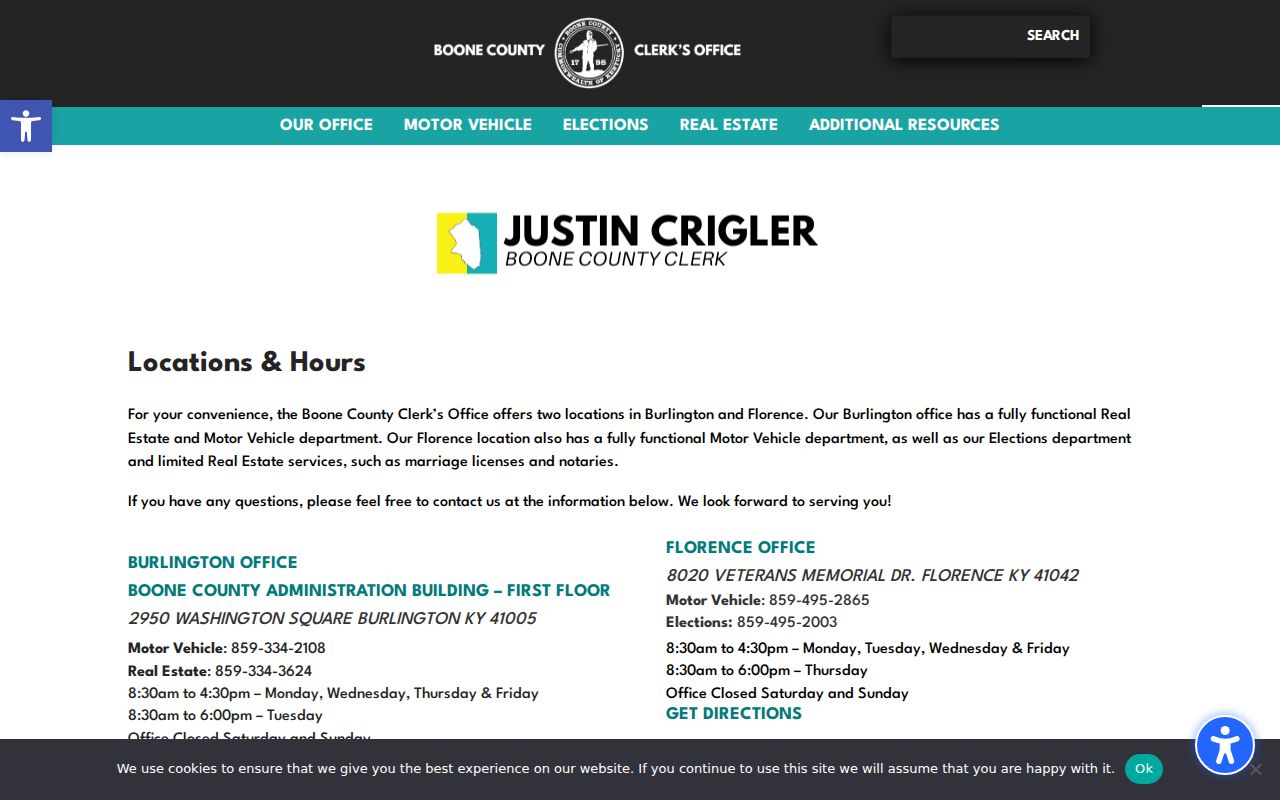
Use Burlington for full land-record research and confirm the service offered at the Florence branch before visiting.
A directory name may also lead to a dated case. The Boone Court of Justice county page identifies the clerk and court divisions that hold the county file.
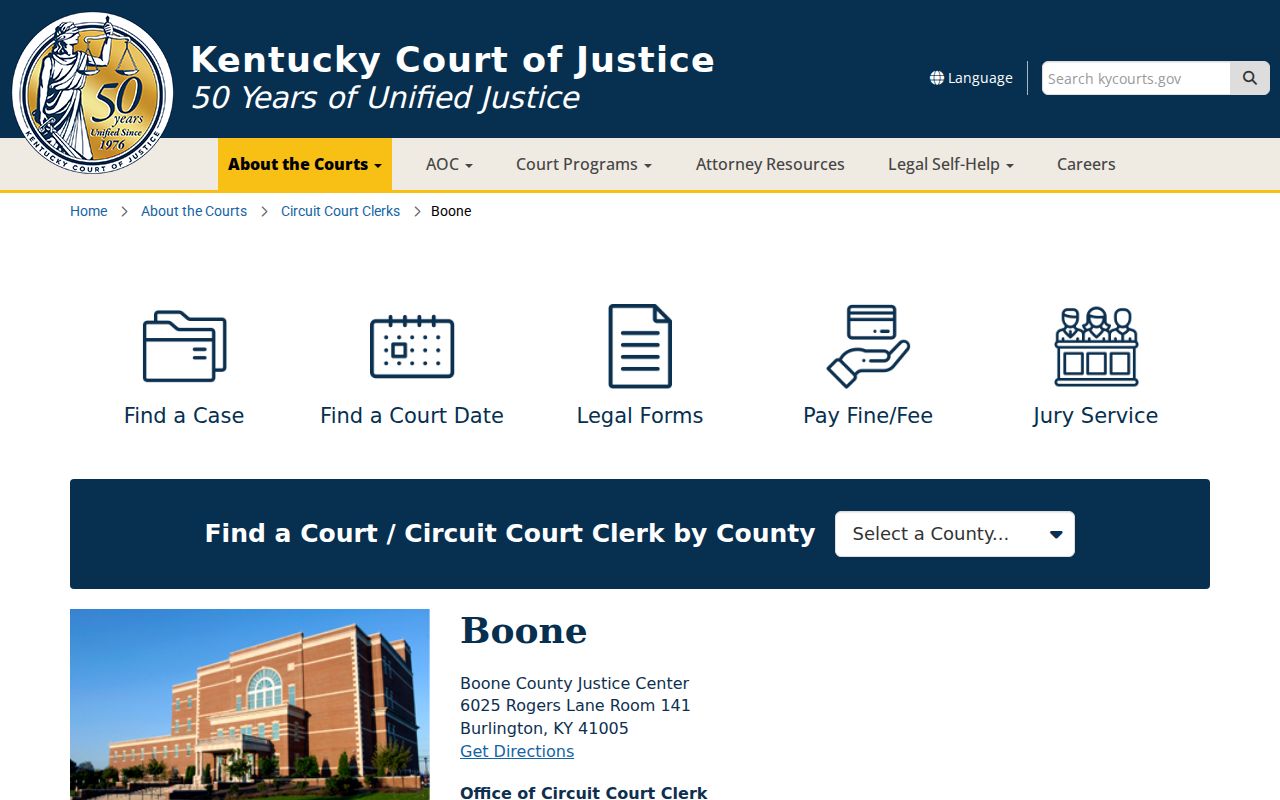
CourtNet is an index rather than the full case file. Ask the clerk or archive for the file after identifying the right case.
Florence Names Across Changing Places
Florence records do not always use today's city and street labels. Official history material includes Pow-Wow, Polecat, and Crossroads as earlier names. The Covington-Lexington Turnpike and later railroad shifts also changed how people and businesses were described. Search those terms in newspapers, church collections, and county material when a modern Florence city directory query fails.
| Date | Florence research milestone |
|---|---|
| 1836 | The turnpike was completed, and Florence served as a stagecoach stop out of Covington. |
| 1870s | Florence was described as Boone's largest town; later rail movement shifted some trade toward Erlanger. |
| 1875-1973 | The currently described digitized Boone Recorder run provides dated local mentions. |
| 1974 | The Florence library branch opened at 2 Girard Street. |
| 1976 | The branch moved to its permanent US 42 site. |
| 2026 | BCPL described its updated linked-record Recollect search. |
Florence Christian Church also served as a Civil War hospital according to city history material. That fact can guide a family researcher toward church, newspaper, cemetery, or military-era sources. It does not substitute for a named record.
Trace Family Through Florence Directories
Build the trail one dated item at a time. A city directory entry is strongest when a census, newspaper, church book, yearbook, deed, or vital record independently supports the same person and place.
- Search the target surname and initials in each available city directory year. Include a spouse, street, and “(F)” marker when the viewer permits.
- Transcribe the page image and save its year, page, scan ID, abbreviations, and full publication title.
- Move one volume earlier and later. Record address changes and gaps without assuming why the listing vanished.
- Pair the nearest directory years with a census year, then test relatives, age, and place facts in the separate census source.
- Search BCPL newspapers, yearbooks, Family Files, and church material for dated links between the directory years.
- Close the trail with an official deed, vital record, court file, or archive record when the research question requires it.
A person can disappear because of a move, death, omission, publisher boundary, changed spelling, or a missing volume. Search an obituary or death clue in the Recorder, Walton Advertiser, Enquirer, Family Files, and church or cemetery material. Keep the source dates separate. For current address-keyed work, use the Florence street directory workflow rather than extending an old listing into the present.