
Florence Previous Residents by Era
No single roll spans the life of a Florence address. Current parcel data supplies a stable parcel ID and legal description. Recorded deeds then name owners, while newspapers, directories, census schedules, and church files can identify past residents. The best source depends on the date being tested.
| Source | Years It Covers | Where Held | What It Shows |
|---|---|---|---|
| Boone deed index | 1992 to present indexed; 1965 to 1992 scanned only | eCCLIX and Boone County Clerk | Grantors, grantees, and recorded instruments |
| Regional directory | 1868 and 1972 samples located | Cincinnati library digital collection | Dated name and address entries |
| Federal census | 1790 to 1950 publicly released | National archives and library platforms | Households and local geography |
| Boone County Recorder | 1875 to 1973 digitized run described | BCPL Recollect and library | Notices, events, property names, and obituaries |
| St. Paul Florence records | 1862 to 1924 | FamilySearch catalog | Church and family connections, subject to item access |
For a recent transfer, start with the PVA and deed index. For a mid-century household, add newspapers, directory pages, and the census nearest the target year. Earlier questions may require BCPL, the Boone County Historical Society, Kentucky archives, or church records. A missing name is not proof that no one lived there.
Anchor Florence Resident Records
Open the Boone County PVA property search and search the site address. Preserve the parcel ID, current owner, legal description, subdivision or lot, and the distinction between the physical site and any mailing address. A mailing address can belong to an owner who receives correspondence elsewhere.
Next, compare the parcel in Boone County GIS. Parcel geometry is often a stronger bridge than a street number. Keep the GIS address point and parcel relationship with the date searched. The PVA basic search is free, while sales search and expanded history are described as subscription features.
This first pass also prevents a common error in previous-residents research: attaching an old name to the wrong lot merely because two addresses look alike. A condominium unit, split tract, corner lot, or annexed parcel may need both its site point and its legal lot reference. Save the source date because assessment fields can change after a transfer.
Record limit. A parcel card establishes an assessed owner, not every person who occupied the Florence home.
Walk Florence Resident Deeds Backward
The Boone County Clerk acts as the land recorder for Florence. Its Real Estate Department and eCCLIX system hold the recorded trail. Start with the present owner and move from each buyer to the person or entity that conveyed the same legal tract.
- Copy the current owner, parcel ID, subdivision, lot, and legal description from PVA.
- Find that owner's purchase deed as a grantee in eCCLIX. Record the grantor, date, book and page, and prior-document references.
- Search that grantor as an earlier grantee. Confirm the same legal description before treating the deed as the prior link.
- Repeat the chain until the indexed range ends. Use scanned books, the Burlington counter, or an archive for earlier links.
- Grantor
- The party conveying an interest in land.
- Grantee
- The party receiving that interest.
- Chain of title
- The linked series of recorded transfers for the same tract.
- Legal description
- The lot, subdivision, boundary, or survey language that identifies land even when its street address changes.
Florence Previous Residents Beyond Indexes
The Clerk's record-room chart draws a vital line. Deeds from D482, beginning in 1992, are scanned and indexed through the present. D170 through D481, covering 1965 to 1992, are scanned but not indexed. A failed name query in that older span may mean the image exists without a searchable entry.
Use the alphabetical series books, a known book and page, or help from the full land-record counter at 2950 Washington Street in Burlington. The Florence clerk location offers limited real-estate functions, so confirm the service before making a trip. eCCLIX image access requires an account, pass, or subscription under its current terms.
The chart does not establish complete online deed coverage before 1965. For that earlier gap, bring the same tract keys to the Clerk and ask whether a deed book, microfilm copy, or archival series is available. Keep a log of searched names and books. That log distinguishes a true gap from a spelling or indexing failure.
Record-room tip. Ask for an instrument type, date range, party spelling, subdivision, lot, and known book or page. Specific keys make an image-only search practical.
Old Florence Resident Geography Matters
Older Florence references may use Crossroads, a turnpike, a church, a post office, or county language rather than today's road number. The official 2024 street index uses an A through J and 1 through 10 grid, which helps place current roads and endpoints. Yet no official citywide renumbering or renaming list was found.
That gap makes the legal description, parcel shape, old maps, directory abbreviations, and annexation exhibits more important. Weaver Road and Hopeful Church Road annexation records show how municipal context can shift around a tract. They do not prove a street number changed, but they can explain why a source classifies the same place differently.
Florence also grew from a turnpike and stagecoach stop into a major Boone town. That history is useful, not decorative: search terms must follow the language used when the record was made.
Florence Previous Residents in Print
A 1972 regional directory supplies a concrete Florence pattern. Entries marked “(F)” can contain a name, spouse in parentheses, occupation, and home address. The collection title refers to Hamilton, so Florence researchers must inspect the page image and marker instead of dismissing it by title.
See the 1972 digitized directory and its Florence entries before relying on OCR. The image below shows the source interface used to locate that evidence.
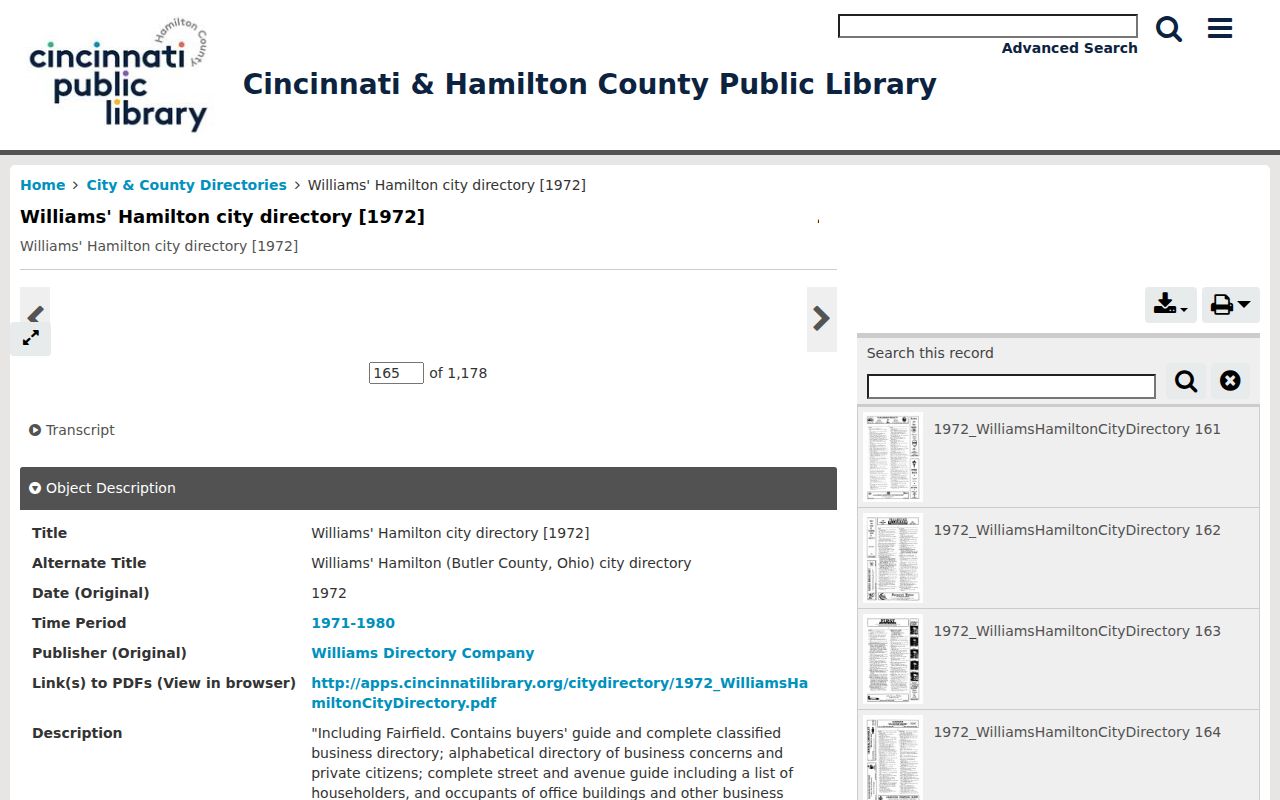
The page image, publication year, and scan identifier turn a name into a dated clue. They still do not establish continuous residence between editions.
Map Florence Resident History Carefully
Fire-insurance maps can show building footprints, materials, and nearby features, but no Florence, Boone County edition was located in the official search used for the research. Never substitute a map for another city with the same name.
The Library of Congress Sanborn search guide explains how to check place, date, edition, sheets, notes, and digital access. Its search view is captured below.
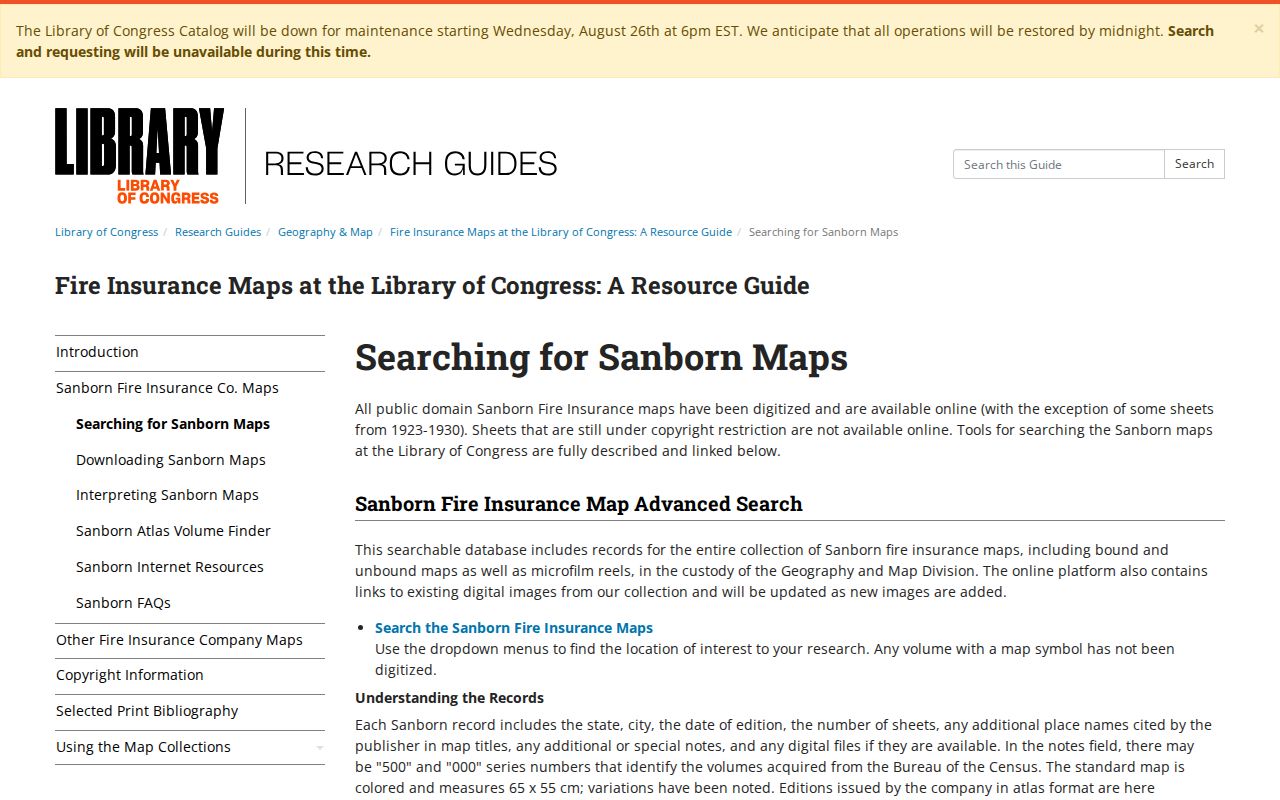
For Florence, combine Boone GIS historical maps, deed descriptions, official street maps, directories, and permit records. Label the missing Sanborn edition as a gap rather than filling it with a guess.
BCPL Extends Florence Resident History
Boone County Public Library's local-history collection bridges online deeds and family evidence. Its holdings include the Boone County Recorder, Walton Advertiser, Cincinnati Enquirer, yearbooks, photographs, Family Files, genealogies, church items, and research appointments. Search all known surnames, old street forms, relatives, schools, churches, and a tight date range.
The Recorder's digitized run is described as 1875 to 1973, and the Walton Advertiser spans 1916 to 1975. Newspaper OCR can miss damaged type. Always open the scanned page and record the issue date, page, named relatives, and address. The Florence Branch is at 7425 US 42, and archive help is available by phone at 859-342-2665 ext. 8134 or historycenterhelp@bcpl.org.
Ask for a focused search rather than “everything” on an address. Give the previous residents' surname variants, an estimated span, nearby roads, and any church, school, or business link. Archive staff can explain whether an item is online, on microfilm, library-only, donor-restricted, or available by appointment.
Florence Residents in Court Archives
Kentucky Department for Libraries and Archives holdings add depth when a deed or obituary points to litigation. The checked Boone list reaches civil and divorce files from 1800 to 1977, criminal files from 1864 to 1960, and order books from 1799 to 1977. These are archive ranges, not a promise of an online name index.
Start with a name, approximate year, case type, and any court clue, then ask KDLA reference staff about access or microfilm. The holdings list did not show a Boone probate-case series. If an estate is the link in the deed chain, confirm custody with the Boone court clerk rather than assuming KDLA has it.
Custody note. Burlington is Boone County's seat, so original county records for a Florence property often lead there.
Confirm Florence Past Households
Owners are only part of the answer. A directory entry can identify an occupant at publication time, while a census schedule can list a household at its enumeration date. BCPL newspapers, Family Files, yearbooks, and church sources can then connect relatives, schools, events, and deaths. Exact Florence reverse-directory runs were not verified, so ask the archive desk rather than claiming they exist.
Use a simple flow: directory year and page, then the nearest released census, then a newspaper or church clue, then a separate legal or vital record when access rules permit. Preserve conflicting spellings. The historical collection details belong to the Florence city directory page, while this backward trail keeps each item tied to the one address.
Kentucky's vital-record genealogy routes explain public periods and archive options. The captured state page below is a starting point, not proof about one past resident.
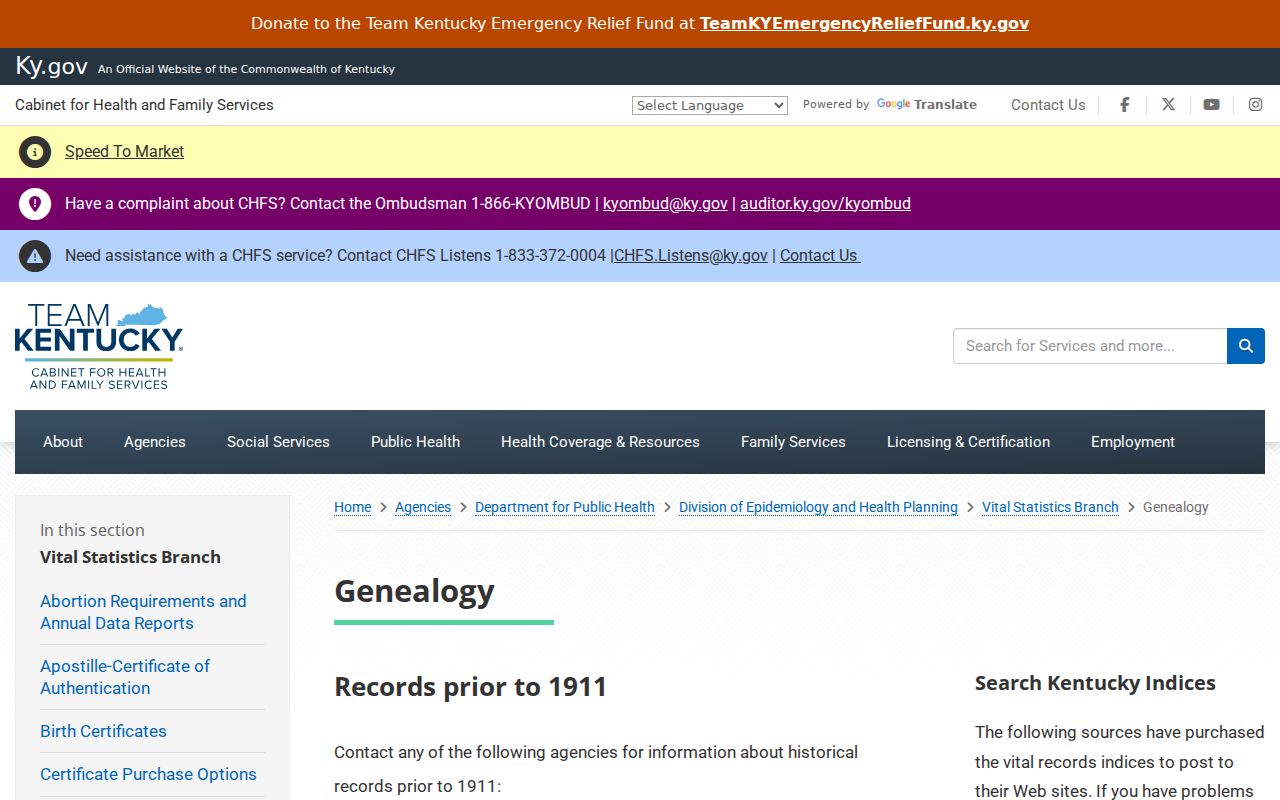
Birth records become public after 100 years and death records after 50 years under Kentucky law. More recent certified records have eligibility rules, so a newspaper clue and a certificate are not interchangeable.
Lawful use. Research previous residents for house history, family history, or personal curiosity. Never use an old address trail to track, harass, or expose a living person.